In this article, I will guide readers through the essential steps of planning and implementing their first AI-powered project. The article will begin with an introduction to the potential benefits of AI for businesses, followed by a discussion of the importance of proper planning. Readers will learn how to define their project goals and objectives, determine their data requirements, decide on the AI technology to use, assemble their team, develop and test the AI model, and deploy and monitor it.

Content here
*Skip long reading.
Introduction Importance of proper planning for AI projects Practice | 1 Understanding the problem that needs to be solved | 2 Identifying the goals and objectives of the project | 3 Understanding the data required for AI projects | 4 Identifying the sources of data and data cleaning methods | 5 Choosing the right AI technology for your project | 6 Identifying the required roles and responsibilities * | 7 Developing the AI model * | 8 Testing and refining the AI model * | 9 Deploying the AI model * | 10 Monitoring and evaluating the model’s performance * Final thoughts
Introduction
As a business technologist with a keen interest in artificial intelligence (AI), I am always excited to explore the potential benefits that this technology can bring to companies. With its ability to automate tasks, analyze large datasets, and make informed decisions, AI is quickly becoming an essential tool for businesses across industries.
One of the key advantages of AI is its potential to streamline operations and increase efficiency. By automating routine tasks, businesses can save time and resources, allowing them to focus on higher-value activities. AI can also improve accuracy and speed up decision-making, enabling companies to respond more quickly to market changes and customer demands.
But the benefits of AI don’t stop there. By analyzing customer data and behavior, companies can gain a deeper understanding of their audience and tailor their products and services accordingly. This can lead to improved customer satisfaction and loyalty, and ultimately, increased revenue.
As someone who has worked on several AI-powered projects, I know firsthand that planning and implementing these initiatives can be challenging, especially for those new to the technology. However, with the right approach and guidance, businesses can leverage AI to transform their operations and achieve their goals.
In this article, I’ll share my insights and practical guidance on how to plan and execute your first AI-powered project. Whether you’re a startup or a well-established company, this guide will help you harness the power of AI to drive your business forward.
Importance of proper planning for AI projects
When it comes to AI projects, proper planning is essential. Unlike traditional software development projects, AI initiatives require careful consideration of several complex factors, including data quality, model selection, and algorithm development. Without a clear plan in place, AI projects can quickly become costly, time-consuming, and fail to deliver the expected results.
One of the key reasons why planning is so critical is that AI projects require significant investments in data preparation and infrastructure. Without a well-defined plan for data collection, cleaning, and organization, it can be challenging to develop accurate and reliable AI models. Similarly, without a clear understanding of the infrastructure requirements, companies may struggle to scale their AI initiatives and may face unforeseen technical challenges.
Another important reason to plan AI projects carefully is to ensure that they align with the company’s strategic goals and business processes. AI projects should be developed with a clear understanding of the company’s overall objectives and should be designed to complement and enhance existing workflows. Without proper planning, AI projects may not integrate seamlessly with the company’s existing processes, leading to inefficiencies and resistance from employees.
Finally, planning is crucial to ensure that AI projects are ethical and transparent. As AI becomes more pervasive, there is an increasing need to ensure that the technology is used responsibly and ethically. A well-defined plan can help ensure that AI projects are developed in a way that respects individual privacy, minimizes bias, and promotes transparency.
Practice
1 Understanding the problem that needs to be solved
The first step in planning an AI project is to understand the problem that needs to be solved. This involves identifying the pain points or challenges that the company is facing and determining how AI can be used to address them.
| Example | A company may be struggling to keep up with the volume of customer service requests they receive, leading to long wait times and dissatisfied customers. AI could be used to develop a chatbot that can handle routine inquiries, freeing up customer service agents to handle more complex issues. Even triggering API calls.
It’s essential to involve key stakeholders in this process, including department heads, subject matter experts, and end-users, to ensure that all perspectives are considered.
2 Identifying the goals and objectives of the project
Once the problem has been identified, the next step is to define the goals and objectives of the project. This involves determining what the company hopes to achieve by implementing an AI solution.
| Example | The goals of an AI-powered customer service chatbot project may include reducing wait times, increasing customer satisfaction, and improving the efficiency of customer service operations. Objectives could include developing a chatbot that can handle a specific percentage of inquiries accurately or reducing the workload on customer service agents by a certain percentage. Look for KPIs to make it tangible.
It’s important to ensure that the goals and objectives are specific, measurable, achievable, relevant, and time-bound (SMART). This helps to ensure that the project is well-defined and that progress can be tracked effectively.
By clearly defining the goals and objectives of the project, the team can ensure that everyone is aligned and working towards the same end goal. This can help to keep the project on track and ensure that it delivers the desired outcomes.
3 Understanding the data required for AI projects
Data is a critical component of any AI project. AI algorithms learn from data, so it’s essential to understand the data requirements for the project. This involves determining the types of data that are needed, such as structured or unstructured data, and the format of the data, such as text, audio, or image data.
| Example | If the AI project aims to develop a predictive maintenance model (as we do) for manufacturing equipment, the data required may include sensor data, maintenance logs, and equipment usage data. The team may also need to determine the frequency and duration of data collection to ensure that the model is accurate and up-to-date.
Remember to incorporate the forthcoming data and landscape alterations into your upcoming AI implementation plans.
4 Identifying the sources of data and data cleaning methods
Once the data requirements have been identified, the next step is to determine the sources of data and the data cleaning methods that will be used. This involves identifying where the data will come from, whether it’s from internal databases or external sources, and the quality of the data.
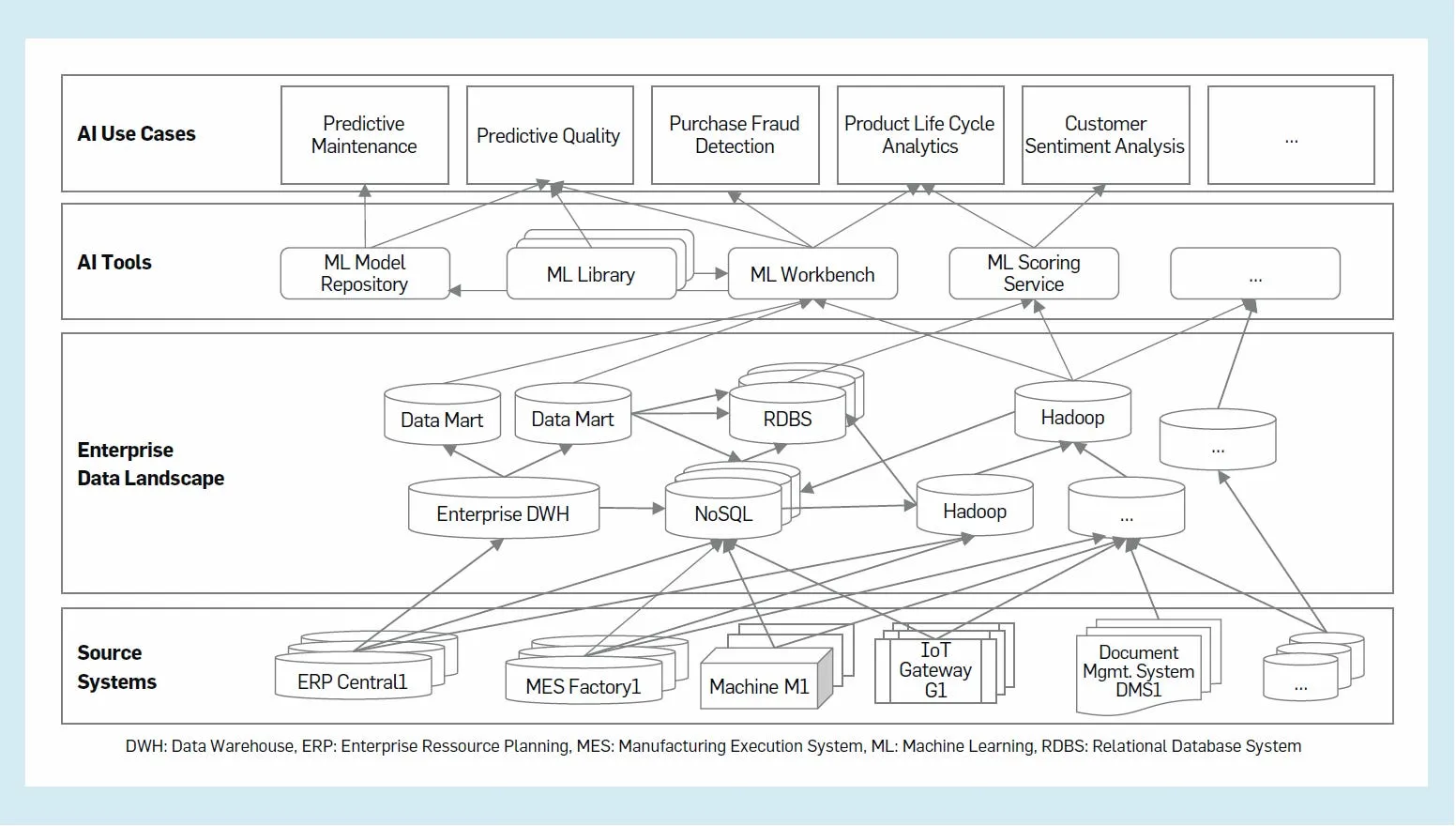
It could be complicated — https://cacm.acm.org/magazines/2021/11/256400-there-is-no-ai-without-data/abstract
Data cleaning is a critical step in the data preparation process, as it ensures that the data used for AI projects is accurate, complete, and consistent. This involves removing or correcting any errors, duplicates, or irrelevant data points, as well as dealing with missing or incomplete data.
The team may need to use various data cleaning methods, such as data normalization, data transformation, and data integration, depending on the types of data and the sources of data. It’s also essential to document the data cleaning process to ensure that the data remains consistent and up-to-date throughout the project.
In summary, determining the data requirements and identifying the sources of data and data cleaning methods are critical steps in planning an AI project. By understanding the data requirements, the team can ensure that they collect and use the right data for the project, and by identifying the sources of data and data cleaning methods, they can ensure that the data is accurate, complete, and consistent.
5 Choosing the right AI technology for your project
Choosing the right AI technology for the project depends on the problem to be solved and the goals and objectives of the project. It’s essential to match the AI technology with the specific needs of the project to ensure that it delivers the desired outcomes.
For example, if the goal is to develop a chatbot for customer service, natural language processing may be the best option. If the goal is to develop a predictive maintenance model for manufacturing equipment, machine learning may be the best option.
It’s also essential to consider the availability of data and the expertise of the team in using the AI technology. Some AI technologies require a significant amount of data and expertise, while others may require less.
Ultimately, the choice of AI technology should be based on a thorough understanding of the problem to be solved, the goals and objectives of the project, and the availability of data and expertise.
6 Identifying the required roles and responsibilities
Assembling the right team is critical to the success of an AI project. Here are some key roles and responsibilities to consider:
- Project Manager: responsible for overall project management, planning, and execution.
- Data Scientist: responsible for data analysis, modeling, and algorithm development.
- Data Engineer: responsible for data infrastructure, architecture, and deployment.
- Machine Learning Engineer: responsible for building and maintaining machine learning models.
- Software Developer: responsible for developing software applications and integrating AI solutions into existing systems.
- Domain Expert: responsible for providing subject matter expertise in the relevant domain.
When building a team, it’s essential to have a mix of technical and domain expertise. Look for individuals with experience in AI technologies such as machine learning, natural language processing, and computer vision. In addition, look for individuals with experience in the relevant domain, such as healthcare, finance, or retail.
Consider partnering with external experts or vendors if the necessary skills are not available in-house. Outsourcing certain aspects of the project can also help in accelerating the project timeline and reducing costs.
7 Developing the AI model
Developing the AI model involves several steps, including:
- Data Preparation: This involves cleaning and preparing the data for analysis, such as removing duplicates, handling missing values, and transforming the data into the appropriate format.
- Feature Engineering: This involves selecting and creating the relevant features that will be used in the AI model.
- Model Selection: This involves selecting the appropriate machine learning algorithm or other AI technology to build the model.
- Model Training: This involves training the AI model on the prepared data.
- Model Evaluation: This involves evaluating the performance of the model using various metrics such as accuracy, precision, and recall.
8 Testing and refining the AI model
Testing and refining the AI model is critical to ensure that it performs well in real-world scenarios. Here are some key steps to consider:
- Testing the Model: This involves testing the model on a separate dataset to evaluate its performance and identify potential issues.
- Refining the Model: Based on the testing results, refine the model to improve its performance. This may involve modifying the data preparation, feature engineering, or model training steps.
- Validation: Validate the model by testing it on real-world data to ensure that it performs well in practice.
- Deployment: Deploy the model into production systems, such as mobile apps or websites, and monitor its performance to ensure that it continues to perform well.
- Continuous Improvement: Continuously monitor and improve the model over time to ensure that it remains effective as the data and business needs evolve.
Overall, developing and testing an AI model is a complex process that requires careful planning and execution. By following best practices and continuously refining the model, businesses can build effective AI solutions that drive meaningful results.
9 Deploying the AI model
Deploying an AI model involves integrating it into production systems, such as mobile apps or websites. Here are some key steps to consider:
- Selecting the deployment environment: Determine the appropriate environment to deploy the model, such as cloud-based platforms or on-premises systems.
- Integration: Integrate the model into the production system, ensuring that it works seamlessly with other components.
- Versioning: Establish version control for the model and ensure that the production system is using the latest version.
- Testing: Test the deployed model to ensure that it is functioning as intended.
10 Monitoring and evaluating the model’s performance
Monitoring and evaluating the model’s performance is critical to ensure that it continues to perform effectively in real-world scenarios. Here are some key steps to consider:
- Establish performance metrics: Establish metrics to monitor the model’s performance, such as accuracy, precision, and recall.
- Continuously monitor: Continuously monitor the model’s performance in production systems, such as by tracking data input/output and error rates.
- Identify issues: Identify any issues with the model’s performance and take corrective action to address them.
- Re-training: Re-train the model periodically to ensure that it continues to perform effectively as the data and business needs evolve.
- Human-in-the-loop: Consider incorporating a human-in-the-loop approach, where human experts can review and provide feedback on the model’s performance.
By deploying and monitoring an AI model effectively, businesses can ensure that it continues to deliver meaningful results and drive business value.
Proper planning is critical for the success of AI projects. By following a well-defined process that includes identifying the problem, defining goals and objectives, determining data requirements, selecting the right AI technology, assembling a team with the necessary skills, developing and testing the AI model, and deploying and monitoring the model’s performance, businesses can ensure that their AI projects deliver meaningful results and drive business value.
Final thoughts
Implementing AI in businesses can be a game-changer. AI can help organizations automate processes, gain insights from vast amounts of data, and make better decisions. However, to be successful, businesses must approach AI implementation with a clear understanding of their goals and objectives, the data required, and the appropriate AI technology to use. They must also have a team with the necessary skills and expertise to develop and deploy AI models effectively.
Overall, the benefits of AI can be substantial, but success requires a strategic approach. By following the steps outlined in this article, businesses can increase their chances of success and achieve meaningful results from their AI initiatives.
Originally published on Medium.