The dust around the release of GLM-5.2 had barely settled when another bomb dropped: Kimi K3. I wanted to understand how these models differ from the previous generation of open-weight models. Another benchmark table is not enough. We need to look at what changed in the architecture, what these models cost in real workloads, and whether any of this has practical significance for enterprise AI.
Spoiler: it does. Just not entirely for the reason that fits most conveniently into a headline.
How close have they come to frontier models?
The overall Artificial Analysis Intelligence Index puts the results in context:
| Model | Intelligence Index |
|---|---|
| Claude Fable 5 | 60 |
| GPT-5.6 Sol | 59 |
| Kimi K3 | 57 |
| Claude Opus 4.8 | 56 |
| GPT-5.5 | 55 |
| GLM-5.2 | 51 |
Kimi K3 is three points behind the leader and ahead of Opus 4.8 and GPT-5.5. GLM-5.2 trails by a wider margin, but 51 is still a serious result for an open-weight model. 3
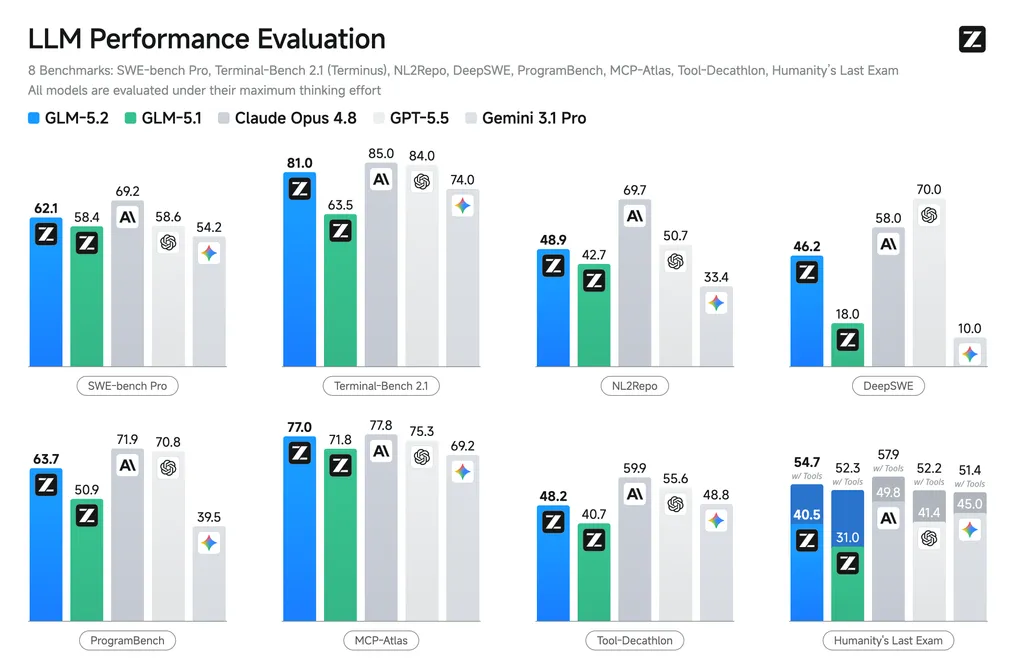
The overall index is useful until the moment you need to choose a model for a specific job. At that point, you have to look at individual tasks.
Coding and long-horizon engineering
| Benchmark | GLM-5.2 | Kimi K3 | Opus 4.8 | GPT-5.5 | Fable 5 | GPT-5.6 Sol |
|---|---|---|---|---|---|---|
| DeepSWE | 46.2 | 67.5 | 59.0 | 67.0 | 70.0 | 73.0 |
| Terminal-Bench 2.1 | 82.7 | 88.3 | 84.6 | 83.4 | 84.6 | 88.8 |
| FrontierSWE | 67.3 | 81.2 | 66.7 | 64.9 | 86.6 | 71.3 |
| SWE-Marathon | 13.0 | 42.0 | 40.0 | 14.0 | 35.0 | 39.0 |
The picture is uneven, which is exactly what makes it interesting. On DeepSWE, GLM-5.2 is well behind the frontier models. On Terminal-Bench, the gap shrinks to a few points, while Kimi K3 almost matches GPT-5.6 Sol.
On FrontierSWE, Kimi K3 beats GPT-5.6 Sol by almost ten points and Opus 4.8 by more than fourteen. On SWE-Marathon, K3 posts the best result among the models in this comparison.
On GDPval-AA v2, which evaluates economically valuable work, Kimi K3 scores 1,668 Elo. That is below Fable 5 and GPT-5.6 Sol, but above Opus 4.8, GPT-5.5, and GLM-5.2. In AA-Briefcase, the agent has to create documents, spreadsheets, presentations, and interfaces from a large set of files. K3 ranks second only to Fable 5. 3
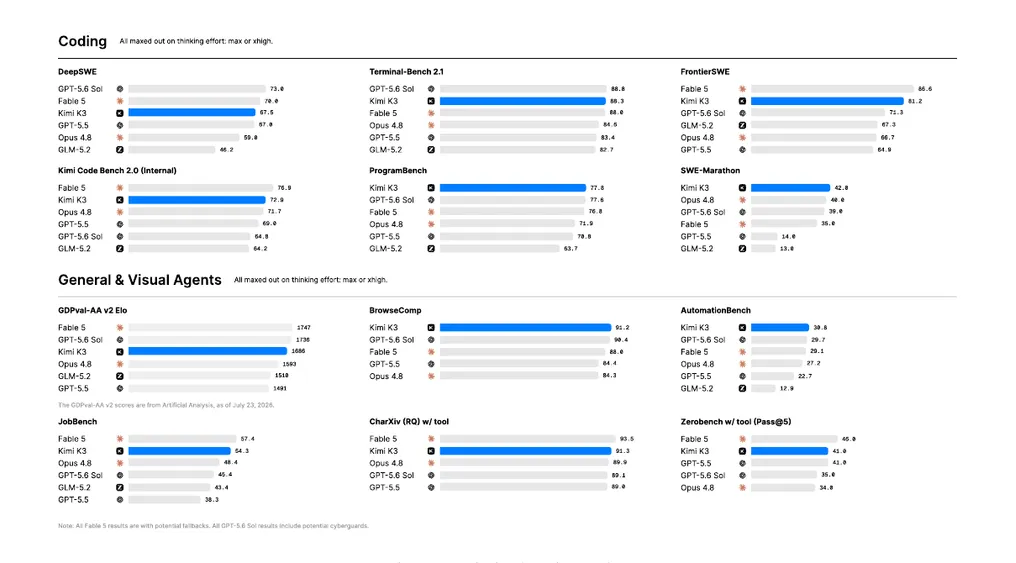
But these are no longer comparisons between models in a laboratory vacuum. Kimi ran inside Kimi Code, Claude inside Claude Code, and GPT inside Codex. In some tests, Fable could switch to Opus 4.8. Certain GPT-5.6 tasks were affected by cyber-safeguard restrictions.
A modern agentic benchmark therefore almost inevitably measures the whole system at once: the model, the harness, tool integration, and context-management strategy. From the user’s perspective, that is reasonable. The user ultimately buys this configuration, not abstract weights floating in a vacuum.
How much do the benchmark gaps matter?
We have looked at the numbers. The more important question is how much these gaps affect model selection in a real project. In my view, the gaps themselves are no longer critical. A company that does not understand which tasks it plans to solve is a much bigger problem.
If the requirement is simply “we need the best model,” Fable 5 or GPT-5.6 Sol remain the obvious choices. On average, they are stronger, more polished, and require less manual supervision. Then again, that requirement is not much more useful than saying, “we need the best server.”
Enterprises rarely buy intelligence in the abstract. A company needs to fix certain classes of bugs, extract data from documents, generate reports, work with internal APIs, and perform operations in a CRM. In other scenarios, the model has to answer support requests, review contracts, build forecasts, conduct research, or create pull requests. For these tasks, the average score matters less than the probability of getting an acceptable result within a reasonable amount of time and money.
For mathematical and scientific tasks, where one error can invalidate the entire result, I would still use a frontier model as the primary option, or at least for final verification. GPT-5.6 Sol, for example, scores 89% on FrontierMath Tier 1-3 and 83% on Tier 4. Fable 5 scores 87% and 87.8%, respectively. 4
This does not mean that Kimi K3 and GLM-5.2 cannot do mathematics. K3 scores 93.5% on GPQA Diamond, while GLM-5.2 scores around 89%. The point is that, in some use cases, the last few percentage points determine the value of the entire system. Saving money specifically on that reasoning step may turn out to be an expensive way to cut costs.
Coding and agentic workflows are different. Results can be checked with tests, a compiler, a linter, static analysis, a sandbox environment, or a second agent. Errors are more often localized and corrected. A model that trails slightly on a general reasoning benchmark may therefore be the better engineering choice.
I would not choose one model for everything. A practical setup might look like this:
- GLM-5.2 handles inexpensive, long-running, and easily verifiable coding tasks.
- Kimi K3 handles complex agentic workflows involving many files, tools, and visual inputs.
- GPT-5.6 Sol or Fable 5 handles the hardest reasoning tasks and verifies critical outputs.
- A small model classifies each request and selects the route.
For an enterprise, this is ordinary workload routing. What is strange is paying the most expensive model to classify every request and move JSON from one format to another.
GLM-5.2 and Kimi K3 came out of different organizations and model families.
Where GLM-5.2 and Kimi K3 came from
GLM-5.2 was developed by Z.ai, formerly known as Zhipu AI. The company emerged from the research environment of Tsinghua University and has been developing the GLM family for several generations.
The releases have arrived at a fairly brisk pace: GLM-5 appeared in February 2026, GLM-5.1 in April, and GLM-5.2 in June. GLM-5 focused on long agentic workflows. In GLM-5.1, the developers improved the model’s ability to preserve working state across hundreds of iterations and thousands of tool calls. GLM-5.2 introduced stable one-million-token context and a more economical sparse-attention implementation. 1
Moonshot AI was founded in 2023. Its technical team includes authors and co-authors of Transformer-XL, RoPE, Mooncake, MuonClip, and other technologies used in modern LLMs. The first Kimi attracted attention for its long context window. In 2025, Kimi K2 became one of the first large open-weight MoE models designed from the start not only for chat and reasoning, but also for agentic tool use. Multimodal K2.5 and K2.6 followed. Moonshot has now scaled that line up to Kimi K3. 2
Kimi K3 has 2.8 trillion parameters, of which 104 billion are activated per token. It contains 896 routed experts, with 16 selected for each token. The model supports images and a context window of roughly one million tokens. On July 27, Moonshot published the full weights and technical report. The term open-weight can now be used without an advance payment, although the model is distributed under the proprietary Kimi K3 License rather than MIT or Apache 2.0. 11
GLM-5.2: Do not pay for the same work several times
GLM-5.2 reached these results without starting from scratch. GLM-5 already used Multi-head Latent Attention and DeepSeek Sparse Attention. MLA was introduced in DeepSeek V2 and scaled in DeepSeek V3. DeepSeek Sparse Attention became the main architectural change in DeepSeek V3.2.
In other words, Z.ai did not merely “take inspiration” from DeepSeek in the vague sense normally used to describe similar ideas. The company took that architectural line and continued developing it. 5
The problem with standard attention
With full attention, every new token can potentially interact with every preceding token. That is manageable with a short prompt. With a context window of one million tokens, repeating the operation across dozens of layers becomes expensive. DeepSeek Sparse Attention adds an indexer that first selects a limited set of the most relevant tokens. The main attention mechanism then operates only on that subset.
The result is a mildly ironic arrangement. We add a mechanism to save compute, then spend a substantial amount of compute deciding what not to compute. The indexer still analyzes a large prefix and repeats the process in every sparse-attention layer.
What IndexShare changes
The GLM engineers found that adjacent layers often select similar context tokens. IndexShare runs the full indexer once for every four sparse-attention layers, and the following three layers reuse the token indices that have already been selected. According to Z.ai, on a one-million-token context this reduces operations per token by a factor of 2.9. An updated Multi-Token Prediction layer also increases the accepted speculative-continuation length by up to 20%. 1
IndexShare was not bolted onto a finished model after training. GLM-5.2 was trained with the mechanism during mid-training on sequences of 128,000 tokens. There is still an element of luck: the mechanism works because the relevant top-k set remains sufficiently stable across adjacent layers. If every layer radically changed its focus, reuse would quickly damage quality.
But the GLM team is not alone in reaching similar results. The authors of IndexCache show that up to 75% of indexer computation can be removed with minimal quality loss. On an experimental model, this accelerated prefill by up to 1.82× and decoding by up to 1.48×. 5
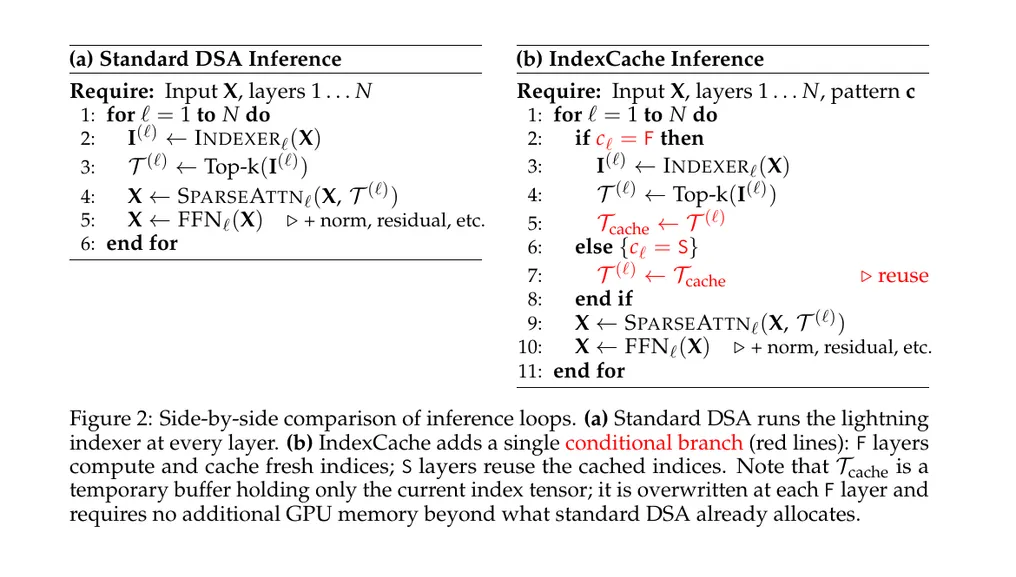
The same pattern runs through all of these changes. KV cache eliminated repeated computation of previous keys and values. MoE made it unnecessary to activate every expert. Sparse attention made it unnecessary to read every token. IndexShare now suggests that we should not repeatedly calculate which tokens need to be read. It is not the most romantic part of AI development, but it is very useful for whoever eventually receives the inference bill.
Kimi K3: Attention across sequence and depth
The logic of GLM-5.2 is relatively straightforward: reduce repeated computation without radically rebuilding the model. Kimi K3 goes considerably further. It combines:
- Kimi Delta Attention;
- Gated Multi-head Latent Attention;
- Attention Residuals;
- Stable LatentMoE;
- 896 routed experts;
- native multimodality;
- quantization-aware training.
I went through these components separately because a list of impressive names sounds convincing while explaining almost nothing.
Kimi Delta Attention
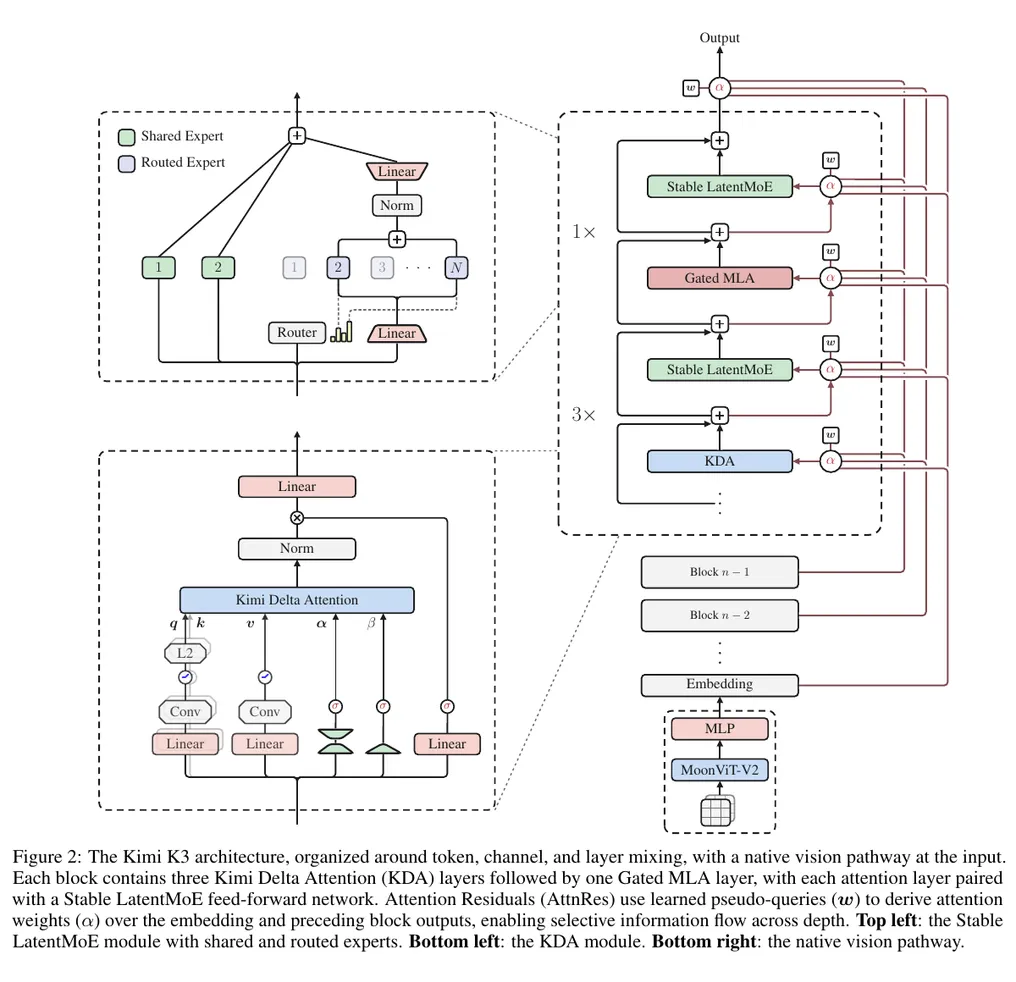
Kimi Delta Attention belongs to the linear-attention family. Instead of storing and processing a full attention matrix, the model updates a compact internal state. In behavior, this partly resembles recurrent memory.
Moonshot uses a hybrid design: three KDA layers alternate with one global Gated MLA layer. KDA accumulates information sequentially, while MLA periodically lets the model access distant parts of the context without that limitation. In the Kimi Linear research model, this configuration reduced KV-cache size by up to 75% and increased decoding speed by as much as six times on a one-million-token context compared with a full-attention baseline.
There is an important caveat. These figures came from an experimental 48-billion-parameter model, not K3. But that work became the basis of the new model’s architecture. 6
Attention Residuals
A standard transformer passes information between layers through a residual stream, with each layer adding its output to the accumulated state. The mechanism is simple and easy to train, but as depth increases, the contribution of an individual layer gradually dissolves into the sum.
Attention Residuals replaces fixed addition with a learned selection process. A new layer can access the outputs of previous layers and decide which representations it needs, much as standard attention selects information along the sequence dimension. Attention Residuals performs this selection along the depth of the model. A full implementation requires a great deal of memory and creates substantial communication overhead between accelerators, so Moonshot developed Block Attention Residuals. Layers are grouped into blocks, and attention operates on their aggregated representations. 6
Stable LatentMoE
Kimi K3 activates 16 experts out of 896. The network is extremely sparse: total capacity is enormous, but a single token uses only a small fraction of it. At this scale, MoE mathematics is no longer the only problem. Tokens must be distributed evenly across experts, overloaded and idle regions must be avoided, data must move between accelerators, and the entire gain from sparsity must not disappear into network communication.
Moonshot used Quantile Balancing for load distribution, Per-Head Muon to optimize individual attention heads, and quantization-aware training with MXFP4 weights and MXFP8 activations. The company recommends deploying K3 on supernode configurations with at least 64 accelerators. So “open model” does not mean “put two GPUs under a desk and never pay anyone again.” 2
KDA also works poorly with traditional prefix caching. The team had to develop a separate prefill-cache mechanism and a vLLM integration. This is the part of the K3 story that interests me most. Architectural innovation does not automatically make inference cheap. First, it gives the inference team a new list of problems. Only later, if everything works, does it start saving money.
Luck or systematic work?
K3 looks impressive, but it does not appear that Moonshot randomly mixed several technologies and immediately produced a frontier model. Kimi K2 already used the company’s MuonClip optimizer, a large system for generating agentic training data, and reinforcement learning through interaction with real and synthetic environments.
KDA was studied separately in Kimi Linear. Attention Residuals went through its own scaling experiments. K3 is the first large model in which several previously tested directions were combined. 6 There is still some luck involved. You can demonstrate that KDA works on a 48-billion-parameter model, test Attention Residuals separately, and train an MoE with hundreds of experts. But nobody can guarantee that all of it will work together reliably at 2.8-trillion-parameter scale.
This is the part of Moonshot’s result that I find most impressive. I do not know how to train models of this size, but the published materials make clear how many independent assumptions had to prove correct at the same time.
Moonshot itself is also quite direct about K3’s limitations:
- quality drops sharply if the agent harness does not return the complete reasoning history to the model;
- the model tends to show excessive initiative;
- with ambiguous instructions, it may make decisions on the user’s behalf;
- the user experience still trails Fable 5 and GPT-5.6 Sol. 2
For an enterprise, these are not footnotes. An agent with access to production systems that decides to take initiative can sometimes be more dangerous than one that simply returns an error.
Are Chinese models still seen as second-tier?
Have these results changed the perception of Chinese models as a category? At the technical level, apparently yes.
The phrase “it is a Chinese model” is no longer a useful predictor of quality. Independent benchmarks place Kimi K3 alongside Opus 4.8 and GPT-5.5. In some coding and agentic scenarios, it outperforms GPT-5.6 Sol and Fable 5. GLM-5.2 is weaker overall, but it offers a strong combination of long-context coding, speed, and cost.
The disappearance of technical skepticism does not remove enterprise risk. Companies still need to determine where data is physically processed, whether the provider supports zero data retention, how stable its APIs and SLAs are, how long a particular version will remain available, and whether the model can be deployed through an independent European or American provider. They should also ask about transparency around training data and post-training, benchmark reproducibility, sanctions exposure, and controllability in agentic mode. This is ordinary vendor due diligence, and the same questions apply to OpenAI, Anthropic, and any other company to which you send data and grant permission to perform actions in your systems.
The model’s country of origin is not an architectural characteristic. The provider’s country of origin remains part of the legal and operational risk profile.
It is easy to draw the wrong conclusion from the size figures. Kimi K3 has 2.8 trillion parameters but activates 104 billion per token. For GLM-5.2, those figures are 744 billion and 40 billion, respectively. Both models use MoE, so comparing total parameters alone says almost nothing about the cost of one inference step. 1 11 Even active parameters are only a rough indicator. Compute depends on attention architecture, context length, weight precision, and serving implementation: K3 was trained with MXFP4 weights, while GLM-5.2 is available in BF16 and FP8. The parameter counts of Fable 5, Opus 4.8, and GPT-5.6 have not been disclosed. These figures therefore do not prove that Chinese laboratories required models several times larger than American ones, or that K3 must be proportionally more expensive than GLM. Comparing 2.8T with 744B describes the architecture, but it does not tell us which model is more efficient.
What needs to happen next?
One strong generation is not enough to permanently reshape the market. To establish trust, Chinese laboratories will need to repeat the result several times:
- Show through independent evaluations that the published weights reproduce the claimed results outside Moonshot’s infrastructure.
- Ensure stable operation across different inference frameworks.
- Maintain predictable licensing terms.
- Continue supporting models after the next version is released.
- Demonstrate reliability not only on benchmarks, but in production workloads.
- Develop enterprise support, observability, and security tooling.
If that happens, hybrid use will become entirely natural. Open-weight models will handle the bulk of verifiable coding, retrieval, and workflow tasks. Frontier APIs will remain for difficult reasoning, quality control, and cases where a few extra percentage points of accuracy justify the price difference. That is the setup I would start with. An enterprise does not need to move its entire AI stack to Kimi or GLM in one quarter. It is enough to assign a limited class of tasks to a new model and measure quality, time, cost, and the amount of manual supervision required.
After several successful cycles, a model’s country of origin will remain one factor in the evaluation, but it will stop replacing the evaluation itself.
Conclusion
GLM-5.2 and Kimi K3 advance open-weight models in different ways. GLM-5.2 systematically removes repeated computation. The idea behind IndexShare is fairly practical: if several layers select almost the same tokens, there is no reason to pay for that decision four times. Kimi K3 changes several architectural levels at once. It optimizes attention across sequence length, routes information across model depth, and controls expert activation inside the MoE.
Fable 5 and GPT-5.6 Sol still look like more mature general-purpose systems. But the question of whether open-weight models can approach the frontier has effectively been answered. They can. The more interesting question now is whether companies will learn to choose a model for the task instead of choosing the top row on a leaderboard.
A model that wins a benchmark and then consumes the entire serving budget is still a bad product decision, however convincing its results table may look.
Sources
- The history of GLM-5, GLM-5.1, and GLM-5.2, along with model parameters, context length, IndexShare, and long-horizon benchmark results, is based on materials published by Z.ai.
- The history of Moonshot AI and the development of the Kimi family are based on the company’s official materials.
- The overall Intelligence Index and coding/agentic benchmarks come from Artificial Analysis and Moonshot’s official comparison. Results depend on the agent harness used.
- The FrontierMath and GPQA results for GPT-5.6 Sol, Fable 5, and other frontier models were published by OpenAI; independent values for GLM-5.2 and Kimi K3 are provided by Artificial Analysis.
- The architectural link between GLM and DeepSeek MLA/DSA is supported by the GLM and DeepSeek reports. Data on the efficiency of cross-layer reuse comes from IndexCache.
- Kimi Delta Attention and Attention Residuals were published by Moonshot before K3 and tested on smaller research models.
- API prices come from the official documentation of Z.ai, Moonshot, Anthropic, and OpenAI. OpenAI requests longer than 272,000 tokens are subject to higher long-context rates.
- Task costs in the Artificial Analysis Intelligence Index: approximately $0.32 for GLM-5.2, $0.94 for Kimi K3, $1.04 for GPT-5.6 Sol, $1.80 for Opus 4.8, and $2.75 for Fable 5.
- Kimi K3 on AA-Briefcase: $10.57, 56.4 minutes, 120,000 output tokens, and 83 turns per task.
- The comparison of GLM-5.2 and Kimi K3 speed and blended token price is based on measurements from Artificial Analysis.
- The weight-release status, full technical report, Kimi K3 parameters, and license terms come from Moonshot’s official repository.